

Program Description
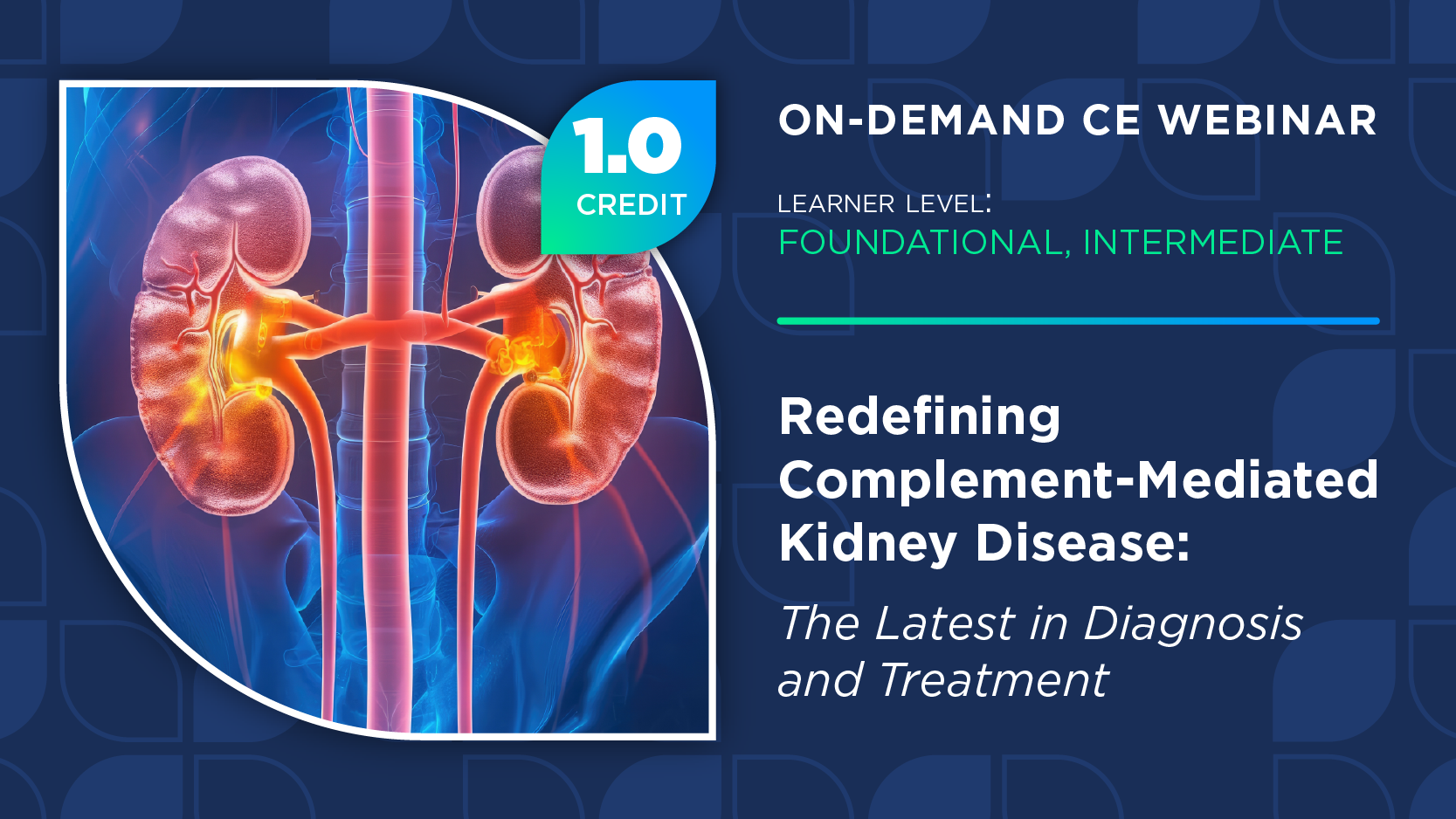
Complement-mediated kidney diseases (CMKDs) represent a complex and progressive group of rare kidney disorders stemming from the dysregulation of the immune system's complement cascade, leading to significant kidney damage. These conditions encompass distinct entities, each with unique pathophysiologies that require accurate differentiation for appropriate diagnosis and targeted therapeutic strategies. While traditional treatments like corticosteroids and immunosuppressants have been utilized, they often present challenges with adverse effects, variable patient responses, and a risk of relapse upon discontinuation. Treatment options are expanding beyond traditional steroids and immunosuppressants, with agents targeting specific areas of the complement pathway. Pharmacists play a crucial role in managing therapies for CMKDs by collaborating with multidisciplinary teams to educate on the latest guidelines and new and emerging treatments, managing drug interactions for complex comorbidities, and facilitating timely referrals for specialty care. Familiarity with new targeted treatments can reduce the burden of disease associated with CMKD, improving patient quality of life and reducing clinical burden. This program will provide pharmacists with essential strategies for counseling patients and caregivers on CMKDs, lifestyle modifications, medication adherence, and the safety and efficacy of new and emerging complement inhibitors for CMKD to optimize patient care.
Target audience: Ambulatory Care Pharmacist, Health System Pharmacist, Specialty Pharmacist
Type of activity: Application
Release date: August 22, 2025
Expiration date: August 22, 2026
Time to complete activity: 1.0 hour
Learner level: Foundational, Intermediate
Fee: Free
Educational Objectives
At the completion of this activity, participants will be able to:
- Explain the role of complement system dysregulation in complement-mediated kidney disease (CMKD) and its impact on disease progression, guiding pharmacologic interventions
- Analyze the safety, efficacy, and mechanisms of action of current and investigational complement inhibitors for CMKD, and customize appropriate therapy based on patient-specific factors
- Identify pharmacist-driven interventions to improve adherence, mitigate adverse effects, and enhance patient understanding of CMKD therapies

Branden D. Nemecek, PharmD, BCPS
Associate Professor of Pharmacy Practice
Duquesne University School of Pharmacy
Internal Medicine and Nephrology Clinical Pharmacist
UPMC Mercy Hospital
Pittsburgh, Pennsylvania

Pharmacy Times Continuing Education™ is accredited by the Accreditation Council for Pharmacy Education (ACPE) as a provider of continuing pharmacy education. This activity is approved for 1.0 contact hours (0.10 CEU) under the ACPE universal activity number 0290-0000-25-282-H01-P. The activity is available for CE credit through August 22, 2026.
Instructions for Completing the Activity and Receiving CPE Credit
To receive CPE credit, participants must complete the pretest, review the activity in its entirety, complete the posttest, and complete the online activity evaluation. After successful completion of the online activity evaluation, you can submit your credit to CPE Monitor. You may view your credit within 48 hours at www.mycpemonitor.net. All participants must request credit before the activity expiration date. CE credit will not be issued after this date.
Disclosures
The following contributors have no relevant financial relationships with commercial interests to disclose:
Faculty
Branden D. Nemecek, PharmD, BCPS
Pharmacy Times Continuing Education™ Planning Staff—Jim Palatine, RPh, MBA; Dipti Desai, PharmD, MBA, CHCP; Sydney Tay; Susan Pordon; Brianna Winters; and Chloe Taccetta have no relevant financial relationships with commercial interests to disclose.
At least one anonymous peer reviewer was used as part of content validation and conflict resolution. The peer reviewer has no relevant financial relationships with commercial interests to disclose.
Educational Disclaimer
CPE activities are offered solely for educational purposes and do not constitute any form of professional advice or referral. Discussions concerning drugs, dosages, and procedures may reflect the clinical experience of the author(s) or they may be derived from the professional literature or other sources and may suggest uses that are investigational in nature and not approved labeling or indications. Participants are encouraged to refer to primary references or full prescribing information resources.
For questions about this internet CPE activity, please contact:
[email protected]
Privacy Policy and Terms of Use Information:
www.pharmacytimes.org/terms
GET STARTED WITH THIS PROGRAM:
Register now to gain access to this program.
Create AccountAlready Registered? Login Here