

Program Description
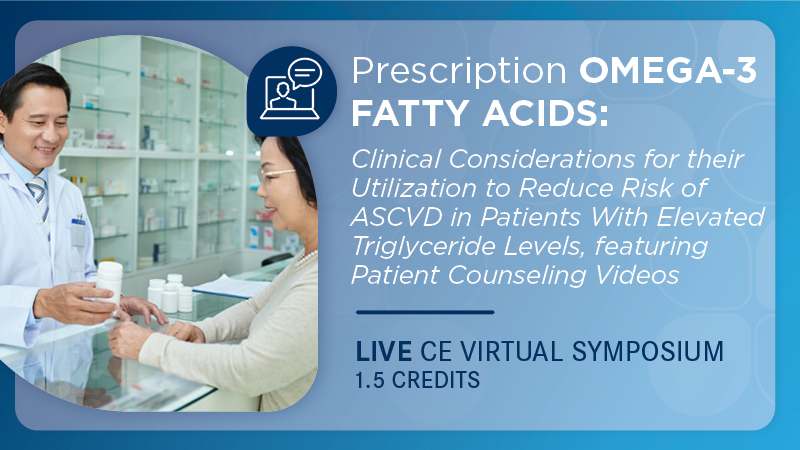
The prevalence of cardiovascular disease is high, and despite optimal treatment with statins, some patients have high risk of an atherosclerotic cardiovascular disease (ASCVD) event because of high triglyceride (HTG) levels. HTG has been confirmed as an independent risk factor for cardiovascular events in epidemiologic and genetic studies, thus defining strategies that may be used to decrease the risk of poor cardiovascular outcomes is essential to decreasing the burden of disease. Familiarity with current prescription omega-3 fatty acids used to lower TG levels in addition to guideline recommendations and clinical trial evidence remains essential to ensure that treatment recommendations are tailored to patients’ needs. As omega-3 fatty acid formulations are available in both prescription and nonprescription options, pharmacists need to help patients understand and differentiate between available formulations. Patient counseling videos are included throughout this activity to provide pharmacists with practical strategies to manage and address patient questions surrounding cardiovascular disease and the use of omega-3 fatty acids.
Target audience: Retail pharmacists
Type of activity: Application
Fee: Free
Educational Objectives
At the completion of this activity, participants will be able to:
- Explain the burden of atherosclerotic cardiovascular disease (ASCVD) and the role of omega-3 fatty acids in reducing ASCVD event risk in patients with elevated triglyceride levels
- Characterize the similarities and differences between available omega-3 fatty acid prescription products
- Examine evidence-based guidelines, recent clinical trial outcomes for omega-3 fatty acids, and how to apply those to the treatment of individual patients
- Investigate the role of the pharmacist in identifying patients with elevated triglyceride levels at high risk for ASCVD events and providing recommendations to reduce ASCVD risk and improve quality of care
Joseph Saseen, PharmD, BCPS, BCACP, CLS
Professor and Associate Dean for Clinical Affairs
Skaggs School of Pharmacy
University of Colorado Anschutz Medical Campus
Aurora, Colorado

Pharmacy Times Continuing Education™ is accredited by the Accreditation Council for Pharmacy Education (ACPE) as a provider of continuing pharmacy education. This activity is approved for 1.5 contact hours (0.15 CEU) under the ACPE universal activity number 0290-0000-21-369-L01-P. The activity is available for CE credit through January 30, 2022.
Instructions for Completing the Activity and Receiving CPE Credit
To receive CPE credit, participants must complete the pretest, view the virtual symposium in its entirety, complete the posttest, and complete the online activity evaluation. After successful completion of the online activity evaluation, you can submit your credit to CPE Monitor. You may view your credit within 48 hours at www.mycpemonitor.net. All participants must request credit before the activity expiration date. CE credit will not be issued after this date.
Disclosures
Joseph Saseen, PharmD, BCPS, BCACP, CLS, has no relevant financial relationships with commercial interests to disclose.
Pharmacy Times Continuing Education™ Planning Staff—Jim Palatine, RPh, MBA; Maryjo Dixon, RPh; Liza Patel, PharmD, RPh; Kelly McCormick; Susan Pordon; Brianna Winters; and Chloe Taccetta have no relevant financial relationships with commercial interests to disclose.
An anonymous peer reviewer has been used as part of content validation and conflict resolution. The peer reviewer has no relevant financial relationships with commercial interests to disclose.
Activity Disclaimer
Pharmacy Times Continuing Education™ (PTCE) strives to provide the highest level of service. However, unforeseen circumstances may necessitate the rescheduling or cancellation of live events, including, but not limited to, webinars hosted by PTCE. PTCE reserves the right to cancel an event without notice. PTCE will not be responsible for any expenditure incurred due to the cancellation.
Educational Disclaimer
CPE activities are offered solely for educational purposes and do not constitute any form of professional advice or referral. Discussions concerning drugs, dosages, and procedures may reflect the clinical experience of the author(s) or they may be derived from the professional literature or other sources and may suggest uses that are investigational in nature and not approved labeling or indications. Participants are encouraged to refer to primary references or full prescribing information resources.
For questions about this live CPE activity, please contact:
[email protected]
Privacy Policy and Terms of Use Information:
www.pharmacytimes.org/terms