
Stream Link: https://event.arraylive.com/app/login/ab057678-48db-4e40-875d-2707e7179d44/virtualattendee
Program Description
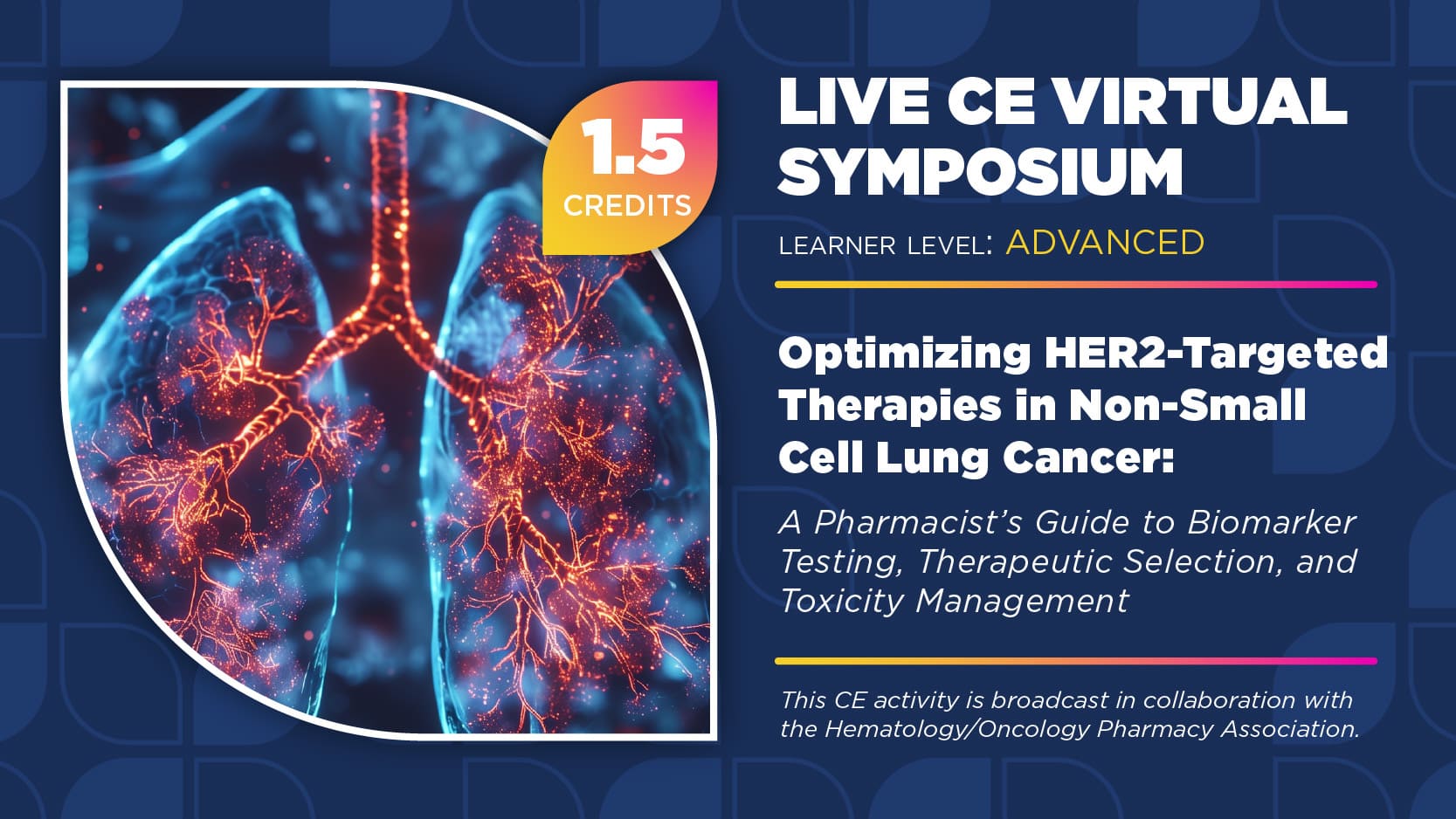
Non‒small cell lung cancer (NSCLC) accounts for approximately 85% of all lung cancer diagnoses and remains a leading cause of cancer-related mortality worldwide. Increasing recognition of oncogenic drivers, including HER2 mutations, amplifications, and overexpression, has expanded the therapeutic landscape, but despite recent advances in molecularly targeted therapies, new diagnostic and management complexities have also been introduced. These distinct HER2 alterations require accurate detection through advanced biomarker testing technologies, which are areas where oncology pharmacists play a pivotal clinical role. As novel HER2-directed therapies, including tyrosine kinase inhibitors, monoclonal antibodies, and antibody-drug conjugates, enter the treatment landscape, pharmacists must navigate evolving data, resistance mechanisms, and toxicity profiles to ensure the delivery of patient-centered, evidence-based care. In this case-driven panel discussion, experts will explore real-world scenarios, discuss emerging evidence, and challenge participants to apply clinical reasoning through opportunities for interactive polling and audience response to topics such as biomarker interpretation, therapy optimization, and toxicity management to improve outcomes for patients with HER2-altered NSCLC.
Target audience: Oncology pharmacists
Type of activity: Application
Release date: April 15, 2026
Expiration date: June 15, 2026
Time to complete activity: 1.5 hours
Learner level: Advanced
Fee: Free
Educational Objectives
At the completion of this activity, participants will be able to:
- Differentiate among HER2 mutations, amplifications, and protein overexpression in non‒small cell lung cancer (NSCLC) based on molecular profiles, clinical implications, and diagnostic approaches
- Identify appropriate HER2-targeted therapy for patients with NSCLC by considering biomarker status, clinical characteristics, current evidence, and guideline recommendations
- Employ pharmacist-driven monitoring, patient education, and dose-modification strategies to effectively manage toxicities associated with HER2-targeted treatments in NSCLC
Alia C. Lynch, PharmD, BCOP
Ambulatory Clinical Lead Pharmacist, Thoracic Oncology
Department of Pharmacy Services
University of Virginia Health System
Charlottesville, VA
Darren Luon, PharmD, BCOP
Clinical Pharmacy Specialist, Thoracic Oncology
Yale New Haven Hospital
New Haven, CT
Shelby L. Quinn, PharmD, BCOP
Oncology Clinical Pharmacy Coordinator
Atrium Health ‒ Levine Cancer Institute
Thoracic/Head & Neck Cancer Clinic
Charlotte, NC

Pharmacy Times Continuing Education™ is accredited by the Accreditation Council for Pharmacy Education (ACPE) as a provider of continuing pharmacy education. This activity is approved for 1.5 contact hours (0.15 CEU) under the ACPE universal activity number [UAN]. The activity is available for CE credit through June 15, 2026.
Instructions for Completing the Activity and Receiving CPE Credit
To
receive CPE credit, participants must complete the pretest, review the activity in
its entirety, complete the posttest, and complete the online activity
evaluation. After successful completion of the online activity evaluation, you
can submit your credit to CPE Monitor. You may view your credit within 48 hours
at www.mycpemonitor.net. All participants must request credit before the
activity expiration date. CE credit will not be issued after this date.
Disclosures
Faculty
Alia C. Lynch, PharmD, BCOP, has the following relevant financial relationship with an ineligible company to disclose:
Advisory Board: Daiichi Sankyo
Shelby L. Quinn, PharmD, BCOP, has the following relevant financial relationships with ineligible companies to disclose:
Advisory Board: Bristol Myers Squibb, Daiichi Sankyo
Darren Luon, PharmD, BCOP, has no relevant financial relationships with ineligible companies to disclose.
Pharmacy Times Continuing Education™ Planning Staff—Jim Palatine, RPh, MBA; Daphne Davis, PharmD, BCOP; Macara Desai; Susan Pordon; Brianna Winters; and Chloe Taccetta have no relevant financial relationships with ineligible companies to disclose.
All of the relevant financial relationships listed for these individuals have been mitigated.
At least
one anonymous peer reviewer has been used as part of content validation and
conflict resolution. The peer reviewer has no relevant financial relationships
with ineligible companies to disclose.
Educational Disclaimer
CPE activities are offered solely for educational purposes and do not
constitute any form of professional advice or referral. Discussions concerning
drugs, dosages, and procedures may reflect the clinical experience of the
author(s) or they may be derived from the professional literature or other
sources and may suggest uses that are investigational in nature and not
approved labeling or indications. Participants are encouraged to refer to primary
references or full prescribing information resources.
For questions about this internet CPE activity, please contact:
[email protected]
Privacy Policy and Terms of Use Information:
www.pharmacytimes.org/terms