
This activity was originally presented at the 2025 HOPA Annual Conference in Portland, Oregon.
This educational content was developed prior to the May 29, 2025 announcement regarding the regulatory status of patritumab deruxtecan. Since the time of content development, the sponsor has withdrawn the Biologics License Application and is no longer seeking FDA approval. Please refer to the most current regulatory guidance for up-to-date information. Learn more
Program Description
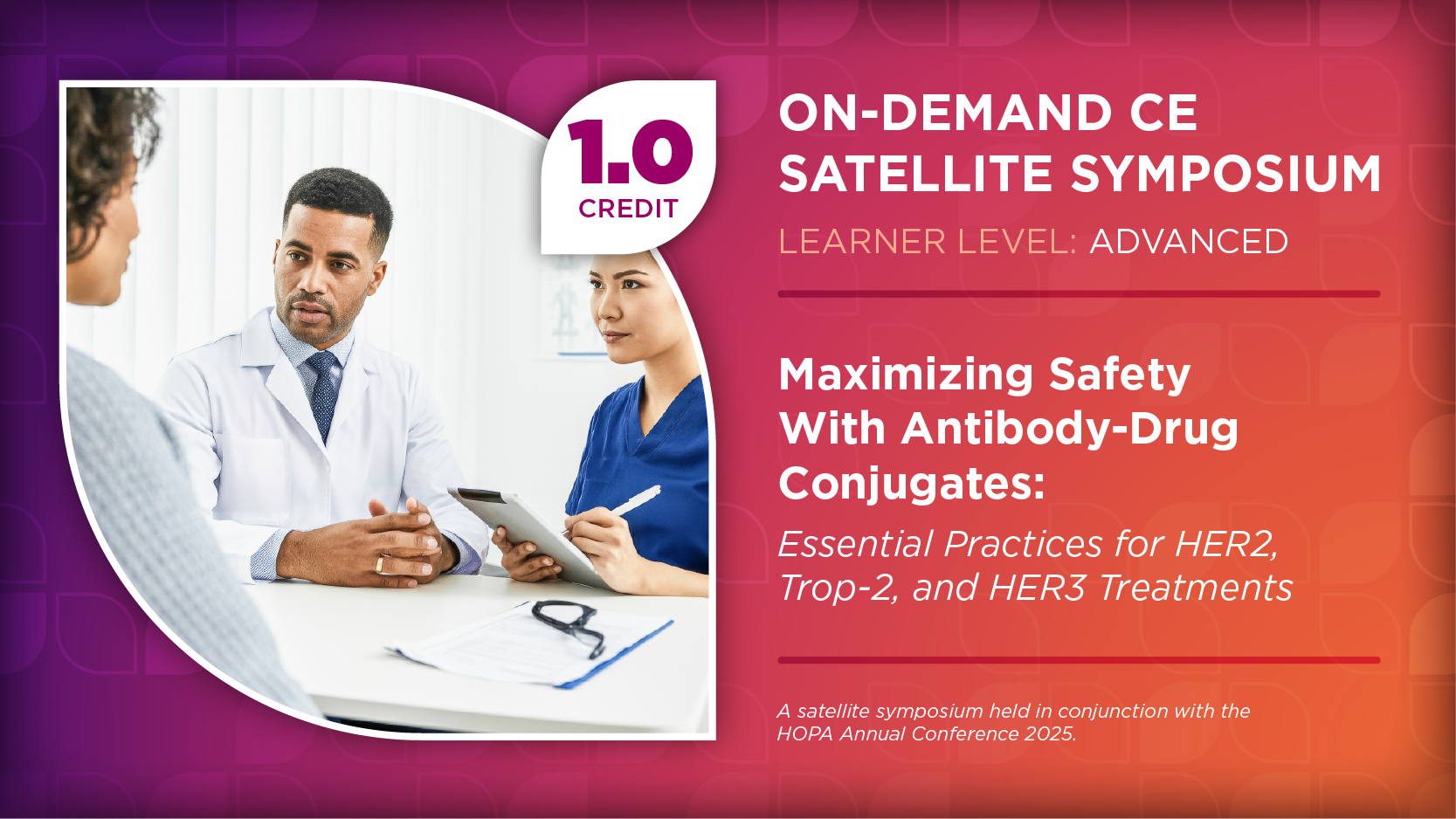
Antibody-drug conjugates (ADCs) have expanded options in cancer treatment, and several ADCs targeting HER2, HER3, and Trop-2 are approved in various malignancies. While ADCs have been designed to minimize toxicity, they can still cause adverse effects (AEs) due to their structural components with on-target and off-target toxicities that vary based on patient-specific factors. As novel ADCs continue to be introduced, oncology pharmacists can apply general principles of AE management to individual patients and educate both health care professionals and patients on strategies to mitigate AEs. This session will examine the central roles and responsibilities of pharmacists within oncology care teams in monitoring patient progress, managing treatment-related toxicities, and developing guidelines for the appropriate use of ADCs. Panelists will review patient case scenarios to illustrate practical AE management strategies and explore emerging challenges with ADCs, such as novel combinations and earlier-line use. Key pharmacologic principles, toxicity considerations, and the latest advancements in ADCs will be discussed.
Target audience: Oncology pharmacists
Type of activity: Application
Release date: April 17, 2025
Expiration date: April 17, 2026
Time to complete activity: 1.0 hours
Learner level: Advanced
Fee: Free
Educational Objectives
At the completion of this activity, participants will be able to:
- Examine the unique toxicity profiles of HER2, Trop-2, and HER3-targeted antibody-drug conjugates (ADCs), considering factors such as tumor type, onset, and patient-specific characteristics
- Apply best practices and intervention techniques for managing ADC-related toxicities to real-world clinical scenarios to improve patient safety
- Analyze how pharmacists can collaborate with other health care professionals to enhance the safety and effectiveness of ADC therapy within a multidisciplinary care setting

Allison Schepers, PharmD, BCOP
Clinical Pharmacist Specialist, Oncology
University of Michigan Rogel Cancer Center
Ann Arbor, Michigan

Matthew J. Hadfield, DO
Developmental Therapeutics
Assistant Professor of Medicine
Brown University/Legorreta Cancer Center
Director
Rhode Island Immunotherapy Toxicity (RiTOX) program
Brown University Health
Providence, Rhode Island

Sarah Donahue, MPH, NP
Nurse Practitioner
UCSF Health
San Francisco, California

Pharmacy Times Continuing Education™ is accredited by the Accreditation Council for Pharmacy Education (ACPE) as a provider of continuing pharmacy education. This activity is approved for 1.0 contact hour (0.10 CEU) under the ACPE universal activity number 0290-0000-25-107-H01-P. The activity is available for CE credit through April 17, 2026.
Instructions for Completing the Activity and Receiving CPE Credit
To receive CPE credit, participants must complete the pretest, review the activity in its entirety, complete the posttest, and complete the online activity evaluation. After successful completion of the online activity evaluation, you can submit your credit to CPE Monitor. You may view your credit within 48 hours at www.mycpemonitor.net. All participants must request credit before the activity expiration date. CE credit will not be issued after this date.
Disclosures
Sarah Donahue, MPH, NP, has the following financial relationships with commercial interests to disclose:
Consultant: AstraZeneca
The following contributors have no relevant financial relationships with commercial interests to disclose:
Faculty
Allison Schepers, PharmD, BCOP
Matthew J. Hadfield, DO
Pharmacy Times Continuing Education™ Planning Staff—Jim Palatine, RPh, MBA; Maryjo Dixon, RPh, MBA; Daphne Davis, PharmD, BCOP; Kylie Ferrentino; Susan Pordon; Brianna Winters; Chloe Taccetta; and Rebecca Green have no relevant financial relationships with commercial interests to disclose.
At least one anonymous peer reviewer was used as part of content validation and conflict resolution. The peer reviewer has no relevant financial relationships with commercial interests to disclose.
Educational Disclaimer
CPE activities are offered solely for educational purposes and do not constitute any form of professional advice or referral. Discussions concerning drugs, dosages, and procedures may reflect the clinical experience of the author(s) or they may be derived from the professional literature or other sources and may suggest uses that are investigational in nature and not approved labeling or indications. Participants are encouraged to refer to primary references or full prescribing information resources.
For questions about this internet CPE activity, please contact:
[email protected]
Privacy Policy and Terms of Use Information:
www.pharmacytimes.org/terms
GET STARTED WITH THIS PROGRAM:
Register now to gain access to this program.
Create AccountAlready Registered? Login Here