
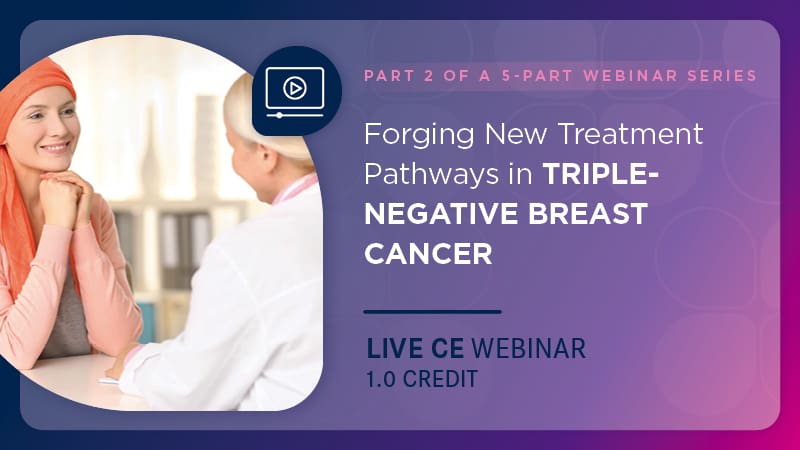
This activity is part 2 of a 5-part webinar series.
Program Description
The management of patients with triple-negative breast cancer (TNBC) can be particularly challenging due to disease complexity and fewer available effective therapies that consider hormone or biomarker targets. The choice of therapy in TNBC is based on goals of therapy, prior therapy, mutational profile of the tumor, biomarker status, and the toxicity profiles of individual agents. But the treatment landscape continues to expand, with poly (ADP-ribose) polymerase (PARP) inhibitors, immune checkpoint inhibitors, and antibody-drug conjugates emerging as options for treatment of patients with TNBC. In this module, pharmacists will explore clinical safety and efficacy data supporting use of these therapies as part of targeted treatment approaches for patients with TNBC.
Target audience: Health-system pharmacists, specialty pharmacists, oncology pharmacists, and managed care pharmacists
Type of activity: Application
Release date: July 28, 2022
Expiration date: September 28, 2022
Time to complete activity: 1.0 hour
Fee: Free
Educational Objectives
At the completion of this activity, participants will be able to:
- Explore the influence of biologic markers and genomic testing on drug therapy selection in metastatic triple-negative breast cancer (mTNBC)
- Examine the role of novel therapies such as poly (ADP-ribose) polymerase (PARP) inhibitors, immune checkpoint inhibitors, and antibody-drug conjugates in the treatment of mTNBC
- Dissect clinical safety and efficacy data supporting the use of novel therapies in the treatment of early stage locally advanced and mTNBC

Allison R. Butts, PharmD, BCOP
Clinical Coordinator, Oncology Pharmacy
Breast Oncology Clinical Pharmacy Specialist
Acute Care Pharmacy Services
UK HealthCare- Markey Cancer
Director, PGY2 Oncology Residency Program
UK HealthCare
Lexington, Kentucky

Pharmacy Times Continuing Education™ is accredited by the Accreditation Council for Pharmacy Education (ACPE) as a provider of continuing pharmacy education. This activity is approved for 1.0 contact hour (0.10 CEU) under the ACPE universal activity number 0290-0000-22-274-L01-P. The activity is available for CE credit through September 28, 2022.
Instructions for Completing the Activity and Receiving CPE Credit
To receive CPE credit, participants must complete the pretest, review the activity in its entirety, complete the posttest, and complete the online activity evaluation. After successful completion of the online activity evaluation, you can submit your credit to CPE Monitor. You may view your credit within 48 hours at www.mycpemonitor.net. All participants must request credit before the activity expiration date. CE credit will not be issued after this date.
Disclosures
Allison R. Butts, PharmD, BCOP, has the following relevant financial relationships with commercial interests to disclose:
Consultant: AstraZeneca, BeyondSpring Pharmaceuticals
Pharmacy Times Continuing Education™ Planning Staff—Jim Palatine, RPh, MBA; Amy Seung, PharmD, BCOP, FHOA; Maryjo Dixon, RPh, MBA; Crissy Wilson; Susan Pordon; Brianna Winters; and Chloe Taccetta have no relevant financial relationships with commercial interests to disclose.
Anonymous peer reviewers were used as part of content validation and conflict resolution. The peer reviewers have no relevant financial relationships with commercial interests to disclose.
Educational Disclaimer
CPE activities are offered solely for educational purposes and do not constitute any form of professional advice or referral. Discussions concerning drugs, dosages, and procedures may reflect the clinical experience of the author(s) or they may be derived from the professional literature or other sources and may suggest uses that are investigational in nature and not approved labeling or indications. Participants are encouraged to refer to primary references or full prescribing information resources.
For questions about this internet CPE activity, please contact:
[email protected]
Privacy Policy and Terms of Use Information:
www.pharmacytimes.org/terms