

This activity was originally presented at the 2026 Directions in Pharmacy (DIP) Conference.
Program Description
Stroke remains a leading cause of long-term disability and mortality. Despite advances in acute management and secondary prevention, many patients remain at high risk for recurrent events, which imposes a substantial clinical and economic burden on patients, caregivers, and health care systems. Standard-of-care antiplatelet strategies have proven to be beneficial but leave a persistent residual risk, with a significant number of patients experiencing another stroke within 90 days. Balancing antithrombotic efficacy against the risk of major bleeding continues to pose a challenge for clinicians and reinforces the need for alternative preventive options.
Emerging Factor XIa (FXIa) inhibitors represent a promising therapeutic approach by selectively targeting the coagulation pathway to prevent thrombosis while preserving normal hemostasis. As these therapies move closer to clinical implementation, pharmacists are ideally positioned within stroke management teams to support consistent application of stroke management guidelines, explain the clinical rationale for FXIa inhibition, and lead individualized approaches to stroke prevention. This session will review opportunities for pharmacists to identify patients at risk for recurrent stroke, apply guidelines and effectively use classification systems, and integrate evidence-based interventions through medication therapy management, patient counseling, and interdisciplinary collaboration to improve outcomes and reduce the burden of stroke.
Target audience: Community pharmacists and retail
pharmacists
Type of activity: Application
Release date: June 30, 2026
Expiration date: June 30, 2027
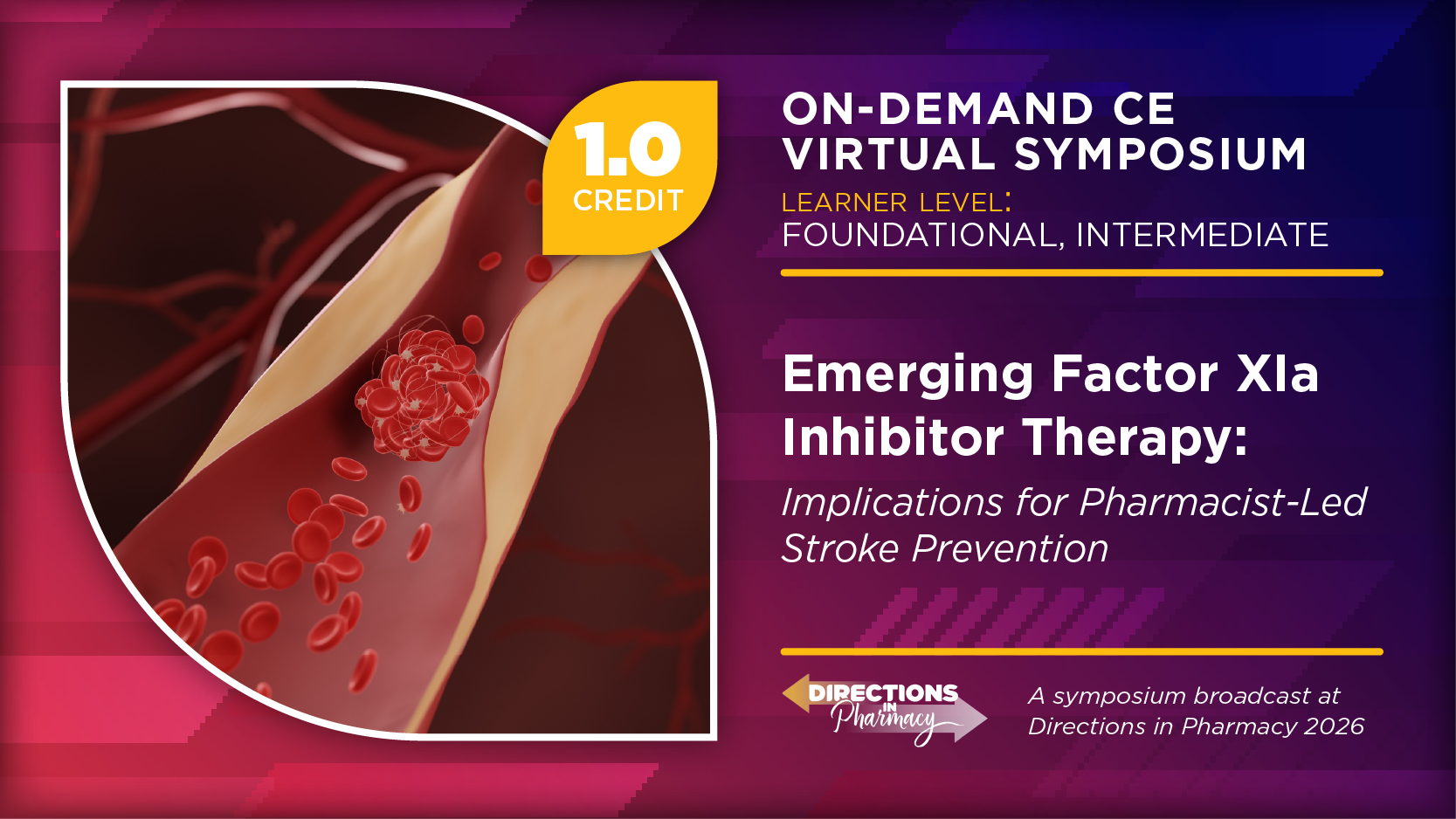
Learner level: Foundational, Intermediate
Time to complete activity: 1.0 hour
Fee: Free
Educational Objectives
At the completion of this activity, pharmacists will be able to:
- Use knowledge of ischemic stroke and the Trial of ORG 10172 in Acute Stroke Treatment (TOAST) classification to identify non-cardioembolic stroke types and choose evidence-based antithrombotic treatments for prevention
- Explain the coagulation cascade, including the rationale for why Factor XIa is targeted, as well as clinical data on investigational Factor XIa inhibitors, focusing on their efficacy and safety
- Demonstrate how pharmacists can improve antithrombotic care via medication therapy management, monitoring adherence, and patient education

Toby C. Trujillo, PharmD, FCCP, FAHA, BCPS
Professor and Vice Chair for Clinical Programs, Cardiovascular Disease, Anticoagulation Management
University of Colorado Anschutz Skaggs School of Pharmacy and Pharmaceutical Sciences
Clinical Specialist, Anticoagulation and Cardiovascular Pharmacotherapy
University of Colorado Hospital
Co-Director, Anticoagulation Stewardship Program
University of Colorado Health
Aurora, CO

Accreditation
Pharmacy Times Continuing Education™ is accredited by the Accreditation Council for Pharmacy Education (ACPE) as a provider of continuing pharmacy education. This activity is approved for 1.0 contact hour (0.10 CEU) under the ACPE universal activity number 0290-0000-26-206-H01-P. The activity is available for CE credit through June 30, 2027.
Instructions for Completing the Activity and Receiving CPE Credit
To receive CPE credit, participants must complete the pretest, view the activity in its entirety, complete the posttest, and complete the online activity evaluation. After successful completion of the online activity evaluation, you can submit your credit to CPE Monitor. You may view your credit within 48 hours at www.mycpemonitor.net. All participants must request credit before the activity expiration date. CE credit will not be issued after this date.
Faculty
The following contributors have no relevant financial relationships with ineligible companies to disclose:
Toby C. Trujillo, PharmD, FCCP, FAHA, BCPS
Pharmacy Times Continuing Education™ Planning Staff—Jim Palatine, RPh, MBA; Adam C. Welch, PharmD, MBA, FAPhA; Emily Tyler; Brianna Winters; and Chloe Taccetta.
Any relevant financial relationships listed for these individuals have been mitigated.
At least one anonymous peer reviewer was used as part of content validation and conflict resolution. The peer reviewer has no relevant financial relationships with ineligible companies to disclose.
Educational Disclaimer
Continuing professional education activities are offered solely for educational purposes and do not constitute any form of professional advice or referral. Discussions concerning drugs, dosages, and procedures may reflect the clinical experience of the author(s) or be derived from the professional literature or other sources and may suggest uses that are investigational in nature and not approved by the labeling or indications. Participants are encouraged to refer to primary references or full prescribing information resources.
For questions about this internet CPE activity, please contact:
[email protected]
Privacy Policy and Terms of Use Information:
www.pharmacytimes.org/terms
GET STARTED WITH THIS PROGRAM:
Register now to gain access to this program.
Create AccountAlready Registered? Login Here