
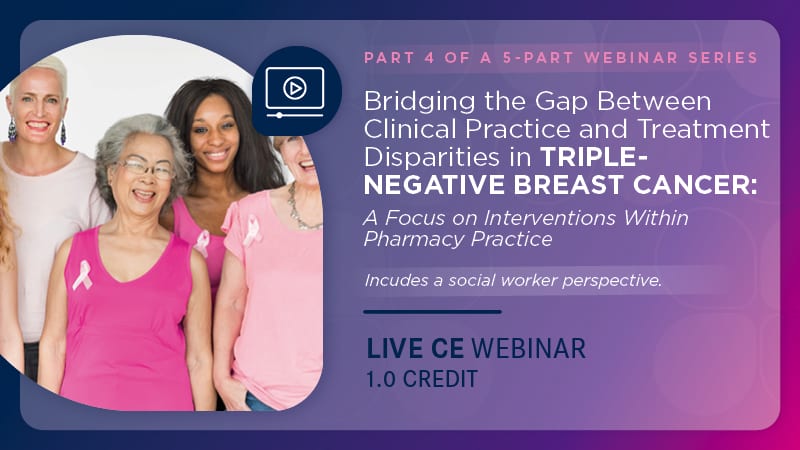
This activity contains a social worker perspective.
This activity is part 4 of a 5-part webinar series
Program Description
Disparities in health care and cancer care can be attributed to multiple socioeconomic, geographic or environmental, and cultural factors. These disparities impact cancer care and outcomes, especially among patients with triple-negative breast cancer (TNBC), due to its poor prognosis and limited targeted therapy options. In particular, TNBC is more commonly diagnosed in African American women, and both biologic and non-biologic factors have been identified as contributing to its incidence in this population. This module will provide pharmacists with tools and resources to identify socioeconomic factors, such as lack of insurance or access to health care, that may adversely impact patients with TNBC. The activity also includes a social worker perspective to add insight into health care disparities and other challenges affecting patients with TNBC.
Target audience: Health-system pharmacists, managed care pharmacists, oncology pharmacists, specialty pharmacists
Type of activity: Application
Release date: August 11, 2022
Expiration date: October 11, 2022
Time to complete activity: 1.0 hour
Fee: Free
Educational Objectives
At the completion of this activity, participants will be able to:
- Examine common disparities in triple-negative breast cancer (TNBC) and their impact on patient care
- Identify situations within pharmacy practice in which disparities may impact the delivery of optimal patient care
- Explore pharmacist-driven strategies to help patients with TNBC overcome treatment disparities and gain access to better care

Veronica Ajewole, PharmD, BCOP
Associate Professor, Pharmacy Practice
Texas Southern University College of Pharmacy & Health Sciences
Houston, Texas
Clinical Pharmacy Specialist−Oncology
Houston Methodist Hospital
Houston, Texas

Pharmacy Times Continuing Education™ is accredited by the Accreditation Council for Pharmacy Education (ACPE) as a provider of continuing pharmacy education. This activity is approved for 1.0 contact hour (0.10 CEU) under the ACPE universal activity number 0290-0000-22-272-L01-P. The activity is available for CE credit through October 11, 2022.
Instructions for Completing the Activity and Receiving CPE Credit
To receive CPE credit, participants must complete the pretest, review the activity in its entirety, complete the posttest, and complete the online activity evaluation. After successful completion of the online activity evaluation, you can submit your credit to CPE Monitor. You may view your credit within 48 hours at www.mycpemonitor.net. All participants must request credit before the activity expiration date. CE credit will not be issued after this date.
Disclosures
The following contributors have no relevant financial relationships with commercial interests to disclose:
Faculty
Veronica Ajewole, PharmD, BCOP
Pharmacy Times Continuing Education™ Planning Staff—Jim Palatine, RPh, MBA; Maryjo Dixon, RPh; Kylie Ferrentino; Susan Pordon; Brianna Winters; and Chloe Taccetta.
An anonymous peer reviewer was used as part of content validation and conflict resolution. The peer reviewer has no relevant financial relationships with commercial interests to disclose.
Educational Disclaimer
CPE activities are offered solely for educational purposes and do not constitute any form of professional advice or referral. Discussions concerning drugs, dosages, and procedures may reflect the clinical experience of the author(s) or they may be derived from the professional literature or other sources and may suggest uses that are investigational in nature and not approved labeling or indications. Participants are encouraged to refer to primary references or full prescribing information resources.
For questions about this internet CPE activity, please contact:
[email protected]
Privacy Policy and Terms of Use Information:
www.pharmacytimes.org/terms